The Hitchhiker’s Guide to Rebranding Machine Learning (And a Shoutout to Geoff Hinton!)
How to Sound Like a Physicist When You’re Really Just Doing Machine Learning
There’s a funny thing that happens when you spend long enough inside the vocabulary of machine learning. Words begin to feel like worn shoes. Loss, gradient, training, inference. After a while you stop hearing them. And then one day a physicist wanders into the room and starts describing the very same things you do for a living, only the words coming out of their mouth sound like they belong on a chalkboard in a faculty lounge somewhere in Göttingen, circa 1925.
It’s the same machinery, of course. Just rotated by ninety degrees, so the light hits it differently.
A small guide to rebranding machine learning
I’ve been keeping a little Rosetta stone of these translations for a while, partly as a joke and partly because I think they genuinely help. Every time you reach for the physics word instead of the engineering one, some quiet door opens in your head and a hallway of intuitions you didn’t know you had comes spilling out. So here it is, the same dictionary I keep in the back of my own head, set out plainly so you can take what you like from it.
| What an engineer says | What a physicist would have said |
|---|---|
| Machine learning | Statistical mechanics |
| Loss function | Energy functional |
| Optimizing the model | Minimizing free energy |
| Trained model | Equilibrium distribution |
| KL divergence | Free energy difference |
| Gaussian noise | Thermal fluctuations |
| Random step | Brownian motion |
| SGD | Directed Brownian motion |
| GPU | Simulated particle accelerator |
| Diffusion models | Langevin dynamics |
| LLMs | High-order discrete Markov chains |
| NLP | String theory (the strings being, well, strings) |
| Reinforcement learning | Control theory |
| Robotics | Physical computation |
| Audio learning | 1D signal processing |
| Image learning | 2D signal processing |
| Video learning | 3D signal processing |
| Multimodal models | n-dimensional signal processing |
There’s a real point hiding inside the silliness here, which is that the borders between fields are mostly historical accidents. Two communities looked at the same elephant from opposite sides of the room and gave it two different names. Noticing that is, I think, one of the small pleasures of being alive at a moment when the disciplines are quietly merging back into each other.
And while we’re here, a word about Geoff Hinton
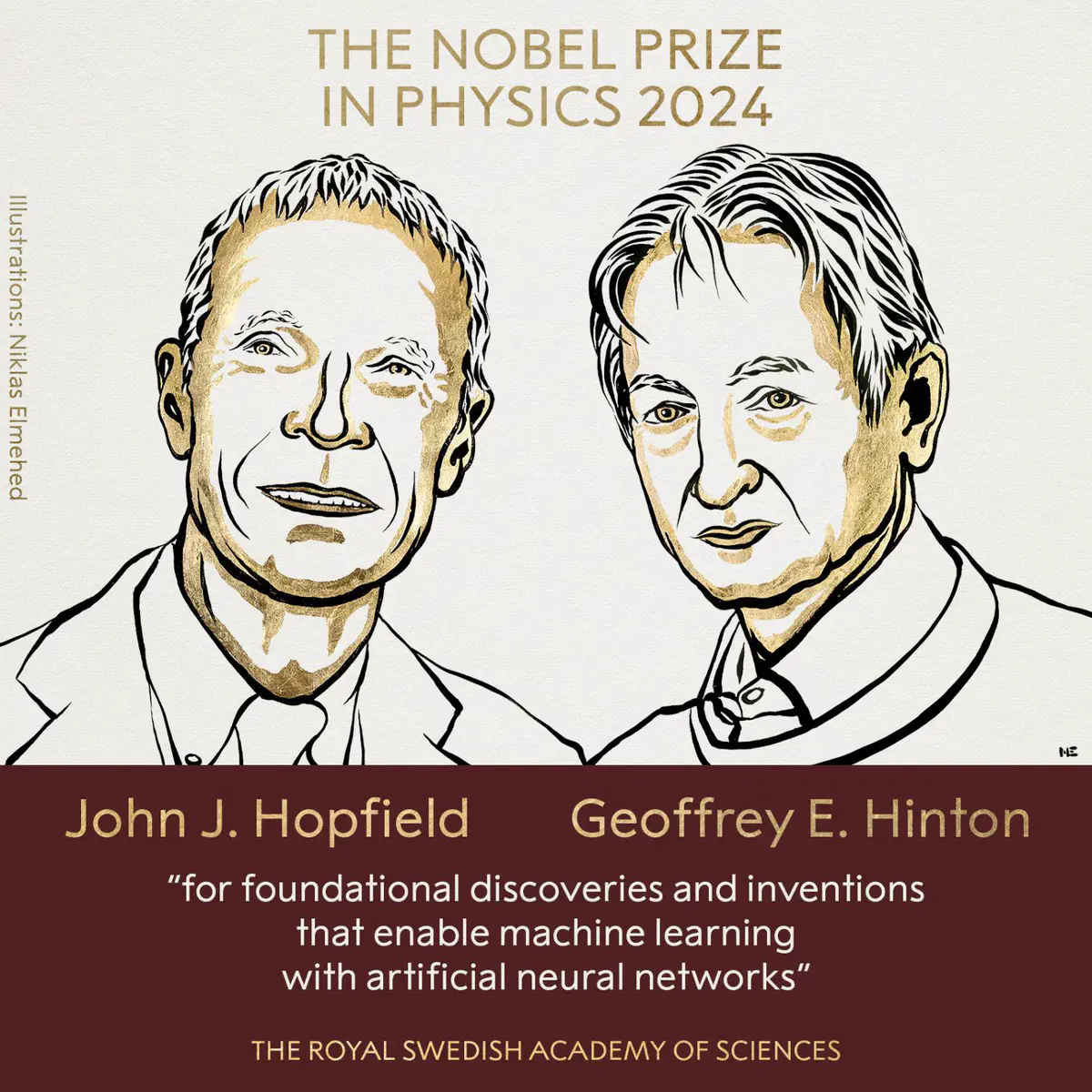
I can’t talk about any of this without pausing for a moment of genuine awe at Geoff Hinton. As of this year he’s the second person ever to hold both a Turing Award and a Nobel Prize. The first was Herbert A. Simon, who picked up his Nobel in Economics. Two people, in the entire history of these prizes, have crossed that particular bridge. Both of them were thinking about minds, and about what it means for a physical system to have one. I find that detail quietly beautiful.
So the next time someone at a dinner party asks what it is you actually do, you have my permission to look them dead in the eye and tell them, in your most serious voice, that you spend your days minimizing free energy in high-order discrete Markov chains using simulated particle accelerators. It happens to be true. It also happens to be the kind of sentence that makes the universe sound a little more like itself.

Mahyar Osanlouy
Scientist | Engineer
My research interests include machine learning and computational neuroscience.